Loving Kindness

Loving Kindness
Showing posts with label African American Studies. Show all posts

Tuesday, January 31, 2012

LETTER FROM A FREEDMAN TO HIS OLD MASTER


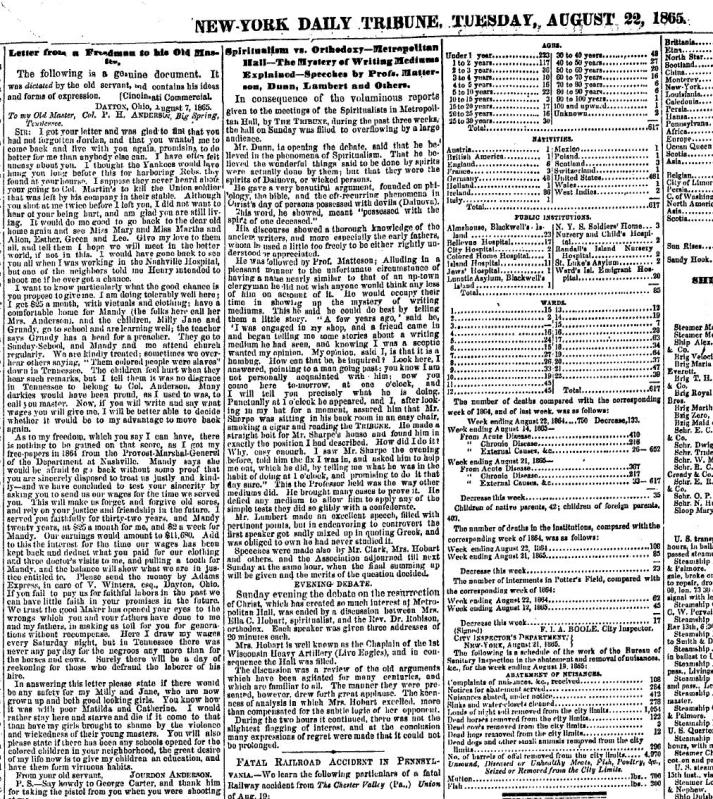
In August of 1865, a Colonel P.H. Anderson of Big Spring, Tennessee, wrote to his former slave, Jourdan Anderson, and requested that he come back to work on his farm. Jourdan — who, since being emancipated, had moved to Ohio, found paid work, and was now supporting his family — responded spectacularly by way of the letter seen below (a letter which, according to newspapers at the time, he dictated).

Rather than quote the numerous highlights in this letter, I'll simply leave you to enjoy it. Do make sure you read to the end.

(Source: The Freedmen's Book; Image: A group of escaped slaves in Virginia in 1862, courtesy of the Library of Congress.)


This letter is generally considered to be authentic.


Courtesy of Letters of Note.


Dayton, Ohio, 

August 7, 1865

To My Old Master, Colonel P.H. Anderson, Big Spring, Tennessee

Sir: I got your letter, and was glad to find that you had not forgotten Jourdon, and that you wanted me to come back and live with you again, promising to do better for me than anybody else can. I have often felt uneasy about you. I thought the Yankees would have hung you long before this, for harboring Rebs they found at your house. I suppose they never heard about your going to Colonel Martin's to kill the Union soldier that was left by his company in their stable. Although you shot at me twice before I left you, I did not want to hear of your being hurt, and am glad you are still living. It would do me good to go back to the dear old home again, and see Miss Mary and Miss Martha and Allen, Esther, Green, and Lee. Give my love to them all, and tell them I hope we will meet in the better world, if not in this. I would have gone back to see you all when I was working in the Nashville Hospital, but one of the neighbors told me that Henry intended to shoot me if he ever got a chance.

I want to know particularly what the good chance is you propose to give me. I am doing tolerably well here. I get twenty-five dollars a month, with victuals and clothing; have a comfortable home for Mandy,—the folks call her Mrs. Anderson,—and the children—Milly, Jane, and Grundy—go to school and are learning well. The teacher says Grundy has a head for a preacher. They go to Sunday school, and Mandy and me attend church regularly. We are kindly treated. Sometimes we overhear others saying, "Them colored people were slaves" down in Tennessee. The children feel hurt when they hear such remarks; but I tell them it was no disgrace in Tennessee to belong to Colonel Anderson. Many darkeys would have been proud, as I used to be, to call you master. Now if you will write and say what wages you will give me, I will be better able to decide whether it would be to my advantage to move back again.

As to my freedom, which you say I can have, there is nothing to be gained on that score, as I got my free papers in 1864 from the Provost-Marshal-General of the Department of Nashville. Mandy says she would be afraid to go back without some proof that you were disposed to treat us justly and kindly; and we have concluded to test your sincerity by asking you to send us our wages for the time we served you. This will make us forget and forgive old scores, and rely on your justice and friendship in the future. I served you faithfully for thirty-two years, and Mandy twenty years. At twenty-five dollars a month for me, and two dollars a week for Mandy, our earnings would amount to eleven thousand six hundred and eighty dollars. Add to this the interest for the time our wages have been kept back, and deduct what you paid for our clothing, and three doctor's visits to me, and pulling a tooth for Mandy, and the balance will show what we are in justice entitled to. Please send the money by Adams's Express, in care of V. Winters, Esq., Dayton, Ohio. If you fail to pay us for faithful labors in the past, we can have little faith in your promises in the future. We trust the good Maker has opened your eyes to the wrongs which you and your fathers have done to me and my fathers, in making us toil for you for generations without recompense. Here I draw my wages every Saturday night; but in Tennessee there was never any pay-day for the negroes any more than for the horses and cows. Surely there will be a day of reckoning for those who defraud the laborer of his hire.

In answering this letter, please state if there would be any safety for my Milly and Jane, who are now grown up, and both good-looking girls. You know how it was with poor Matilda and Catherine. I would rather stay here and starve—and die, if it come to that—than have my girls brought to shame by the violence and wickedness of their young masters. You will also please state if there has been any schools opened for the colored children in your neighborhood. The great desire of my life now is to give my children an education, and have them form virtuous habits.

Say howdy to George Carter, and thank him for taking the pistol from you when you were shooting at me.

From your old servant,

Jourdon Anderson.

_____________________________________________________________________
People have questioned the authenticity of the letter. There seems to be no absolute way to 100% verify its authenticity at this point especially without the letter reportedly sent to Jourdan Anderson. The leter did appear in several newspapers of the day. That lends some degree of credibility though that is not absolute.

Additionally...

Apparently, this letter is from a real book published in 1865 by an abolitionist named Lydia Maria Child. Apparently, the letter was dictated to a literate person by a recently freed slave. The letter could be a complete fabrication on her part, but that seems unlikely given that she names the slave master in question and gives his location. And she apparently also helped Harriet Jacobs with her own popular slave narrative, Incidents in the Life of a Slave Girl.

Child's work, including the book in which this letter appears, is discussed in the documentary Over the River. 

Lydia Maria Child (February 11, 1802 – October 20, 1880) was an American abolitionist, women's rights activist, opponent of American expansionism, Indian rights activist, novelist, and journalist and Unitarian.

Her journals, fiction and domestic manuals reached wide audiences from the 1820s through the 1850s. She at times shocked her audience, as she tried to take on issues of both male dominance and white supremacy in some of her stories.

Saturday, December 3, 2011

THE BEST OF MOYO AFLAME 2011: Why The Eradication of Both White Privilege and Racism Have To Be a Part of the Progressive/Liberal Agenda, Part III, Finale


This piece originally appeared on Moyo Aflame on October 25, 2011

People get tired of racism. People get tired of talking about racism. People get tired of listening to other people talk about racism. It is not only people who are somewhat or largely racist who tire of these discourses. Many people get tired of this topic. I am strongly pushing the bounds of tolerance simply by composing a three part series on this blog about it. Even some of my most loyal fans will likely roll their eyes and shake their heads in disbelief and exasperation when they discover I have written yet another installment on the subject. That's just how averse we are in America to talking about racism. 

I have learned that virtually everyone (who is not black or brown) or who is not very seriously engaged in and committed to some form of active anti-racist work, eventually gets tired of talking about racism and wants to move on to another topic of discussion. Racism is not a sustainable conversation with a very large cross section of American citizens. And if racism is not a sustainable topic, the topics of white privilege and white supremacy, both being realities that are required for racism to even exist, don't really even stand a chance of making it out of the birth canal. It is very much like we as a people are engaged in a type of stealth like behavior, when it comes to discussions around race and white supremacy. We are lying in wait for any random cataclysmic, newsworthy or even pop confection of a story to break so that we can exhale a huge sigh of relief and completely pounce on this new thing, full force, whatever it is, and give energy to it instead of to the ongoing and always relevant discussion of racism.

The problem of course, is that so many of these new things especially the big ones also have very clear racialized or race related and white privilege/supremacy aspects, energies or undertones to them that are so powerful they often simply cannot be ignored---Hurricane Katrina, the signs present at early and ongoing Tea Party rallies, the rhetoric that emerged from those early and ongoing Tea Party rallies, bitherism, the passage of California's proposition 8, the American recession, the passage of Arizona's SB 1070, the ongoing , persistent and unprecedented disrespect and racialized name calling and lampooning aimed at President Obama and First Lady Michelle Obama, the passage of Alabama's HB 56, the execution of Troy Davis, etc. America is anything but a post racial society yet so many of us so desperately want it to be. This desire is so deep and so insidious it has become as ingrained in the American ethos as racism itself.

Its easy to understand why Americans are so eager to move past racism. It is a very ugly yet integral part of our past history and current reality. It is a national embarrassment. And most people don't enjoy being embarrassed. We tend to want to move past embarrassing episodes in our personal lives as quickly as humanly possible. The same is true for our national lives as well. And it is not just African Americans who have been subjected to the American brand of ethnic based bias, of course. This is a country of the occupied, the enslaved and of immigrants. Every single occupied indigenous nation, family with enslaved ancestors and every immigrant group who has found themselves within the borders of the sea to shining sea-ness known as America has experienced some form of horrifying legacy of ethnicity based bias within these borders. There are the Native people's whose land was initially appropriated, The Jews, The Irish, The Italians, The Germans, The Japanese, The Chinese, The Vietnamese, The Mexicans, The Nicaraguans, The El Salvadorans, etc. One could write a very good and very compelling history of America simply by writing it through the prism of our history of racism and the stain of ethnicity based bias.

Many people also have a very poor level of competency when it comes to discussions around racism. There are voluminous misconceptions. There is a lot of disinformation. People are uneducated or under educated about the subject. People have been told lies that they believe even if covertly so. Some people with media power deliberately repeat these lies. People get very defensive. Some people get seriously irrational. People feel guilty. People feel shamed. Some people experience it as the ultimate "gotcha" conversation. Some are competitive enough to never want to engage in a discourse where they are on the wrong side of that gotcha. People feel buzz killed. I have compassion for all of that. I honestly do. And you know what? Get over it. Because the result of not getting over it, as whomever the genius was in early AIDS activism so solemnly bemoaned, silence = death. It really is as simple as that for me when it comes to my lack of tolerance for people's desire to avoid conversations about race. Silence equals death.

There was a video that circulated around the internet a while ago. It was Morgan Freeman talking to Mike Wallace on 60 Minutes about race. Freeman's antidote on the topic was to simply cease and desist when it came to discussions about racism. Morgan Freeman is an imposing and convincing person. Many of my white facebook friends tagged me on their sharing of the video. They praised it endlessly. I was captivated by the video. The teacher of conscious living part of me who understands that one gives power to that which one speaks about, knew exactly what Morgan Freeman was talking about and was drawn in almost completely...but not quite. As more and more of my white friends engaged in deeper and deeper and more enthusiastic praise for Freeman's perspective, I began to notice that none of my black friends were responding to it similarly. And I have many black friends with very strong opinions. Many white Americans desperately want to move past Americas racist history. Black folks response to that is more often along the lines of, "Uh, hold on Sally." Morgan Freeman, I believe, is in an interesting minority in his perspective as far as black Americans go. Lets explore this deeper, shall we.

I went back and watched the Morgan Freeman 60 Minutes interview video again, and again, and again and a few things began to pop out at me. First, there is the undeniable fact that Morgan Freeman has far more class and other forms of privilege than the vast majority of other African Descended men and women in America do. This is important. Its difficult to imagine this having no bearing at all on his philosophy whatsoever. I believe it is largely his privilege speaking when he adopts his colorblind philosophy. Second, in the interview, in defense of his essentially colorblind philosophy, Freeman says to Mike Wallace, "I am going to stop calling you a white man and I'm going to ask you to stop calling me a black man." Seems simple enough, right? For me however, there is one glaring problem with this approach being taken up specifically by Morgan Freeman. 

Here it is:

I very recently watched the video of this exchange yet again. In the meantime, since recording the original program with Wallace, Morgan Freeman has been featured on one of the installments of Professor Louis Henry "Skip" Gates Jr's PBS genealogy program, African American Lives. On this program it is revealed that, like many blacks from The South with the same last name, Freeman's name was taken when his ancestor became free from slavery, as a direct and unmistakable nod to that momentous event. Hence, Free Man. So every single time he is referred to as a black man and especially when he is addressed with the inclusion of his last name or whenever his last name appears in print, Freeman's connection to America's slavery/racist past is being conjured up...literally. And he wants to try to forget that? Move past that? Well, sorry, he can't no matter how hard he tries. It is literally a part of him.

The other big problem with Freeman's approach is that colorblindness usually equals some form of active denial or complicity when the issue is America's relationship to its own racial history and contemporary reality. There is no better place to observe this than in liberal, progressive white America that often believes colorblindness is a very good thing. It isn't. I do believe in the spiritual understanding that we give power to what we speak about. I have discovered however, that there are clear limitations to the application of this. When it comes to social justice advancements in the recorded history of humankind, such advancements have never, ever been achieved through silence. They've never ever been achieved simply through osmosis. They have been achieved through acknowledgment and then the long, hard work that follows and always with the ongoing acknowledgement just a half step behind whatever the current hard work calls for. Morgan Freeman's solution may be an appropriate one at some point in America's future. It is not a solution for the current American ethos around the issues of race, white supremacy, white privilege and black oppression and genocide.

On-site links:
Why The Eradication of Both White Privilege and Racism Have To Be a Part of the Progressive/Liberal Agenda, Part I


Why The Eradication of Both White Privilege and Racism Have To Be a Part of the Progressive/Liberal Agenda, Part II, OCCUPIED Edition

Tuesday, October 25, 2011

Why The Eradication of Both White Privilege and Racism Have To Be a Part of the Progressive/Liberal Agenda, Part III, Finale


People get tired of racism. People get tired of talking about racism. People get tired of listening to other people talk about racism. It is not only people who are somewhat or largely racist who tire of these discourses. Many people get tired of this topic. I am strongly pushing the bounds of tolerance simply by composing a three part series on this blog about it. Even some of my most loyal fans will likely roll their eyes and shake their heads in disbelief and exasperation when they discover I have written yet another installment on the subject. That's just how averse we are in America to talking about racism.

I have learned that virtually everyone (who is not black or brown) or who is not very seriously engaged in and committed to some form of active anti-racist work, eventually gets tired of talking about racism and wants to move on to another topic of discussion. Racism is not a sustainable conversation with a very large cross section of American citizens. It is very much like we as a people are engaged in a type of stealth like behavior, when it comes to discussions around race. We are lying in wait for any random cataclysmic, newsworthy or even pop confection of a story to break so that we can exhale a huge sigh of relief and completely pounce on this new thing, full force, whatever it is, and give energy to it instead of to the ongoing and always relevant discussion of racism.

The problem of course, is that so many of these new things especially the big ones also have a very clear racialized or race related aspect, energy or undertone to them that is so powerful it often simply cannot be ignored---Hurricane Katrina, the signs present at early and ongoing Tea Party rallies, the rhetoric that emerged from early and ongoing Tea Party rallies, bitherism, the passage of California's proposition 8, the American recession, the passage of Arizona's SB 1070, the passage of Alabama's HB 56, the execution of Troy Davis, etc. America is anything but a post racial society yet so many of us so desperately want it to be. This desire is so deep and so insidious that it has become as ingrained in the American ethos as racism itself.

Its easy to understand why Americans are so eager to move past racism. It is a very ugly yet integral part of our past history and current reality. It is a national embarrassment. And most people don't enjoy being embarrassed. We tend to want to move past embarrassing episodes in our personal lives as quickly as humanly possible. The same is true for our national lives as well. And it is not just African Americans who have been subjected to the American brand of ethnic based bias, of course. This is a country of the occupied, the enslaved and of immigrants. Every single occupied indigenous nation, family with enslaved ancestors and every immigrant group who has found themselves within the borders of the sea to shining sea-ness known as America has experienced some form of horrifying legacy of ethnicity based bias within these borders. There are the Native people's whose land was initially appropriated, The Jews, The Irish, The Italians, The Germans, The Japanese, The Chinese, The Mexicans, The Nicaraguans, The Salvadoreans, etc. One could write a very good and very compelling history of America simply by writing it through the prism of our history of racism and the stain of ethnicity based bias.

Many people also have a very poor level of competency when it comes to discussions around racism. There are voluminous misconceptions. There is a lot of disinformation. People are uneducated or under educated about the subject. People have been told lies that they believe even if covertly so. Some people with media power deliberately repeat these lies. People get very defensive. Some people get crazy. People feel guilty. People feel shamed. Some people experience it as the ultimate "gotcha" conversation. Some are competitive enough to never want to engage in a discourse where they are on the wrong side of that gotcha. People feel buzz killed. I have compassion for all of that. I honestly do. And you know what? Get over it. Because the result of not getting over it, as whomever the genius was in early AIDS activism so solemnly bemoaned, silence = death. It really is as simple as that for me when it comes to my lack of tolerance for people's desire to avoid conversations about race.

There was a video that circulated around the internet a while ago. It was Morgan Freeman talking to Mike Wallace on 60 Minutes about race. Freeman's antidote on the topic was to simply cease and desist when it came to discussions about racism. Morgan Freeman is an imposing and convincing person. Many of my white facebook friends tagged me on their sharing of the video. They praised it endlessly. I was captivated by the video. The teacher of conscious living part of me who understands that one gives power to that which one speaks about, knew exactly what Morgan Freeman was talking about and was drawn in almost completely...but not quite. As more and more of my white friends engaged in deeper and deeper and more enthusiastic praise for Freeman's perspective, I began to notice that none of my black friends were responding to it similarly. And I have many black friends with very strong opinions. Many white Americans desperately want to move past Americas racist history. Black folks response to that is more often along the lines of, "uh, hold on Sally." Morgan Freeman, I believe, is in an interesting minority in his perspective as far as black Americans go. Lets explore deeper.

I went back and watched the Morgan Freeman 60 Minutes interview video again, and again, and again and a few things began to pop out at me. First, there is the undeniable fact that Morgan Freeman has far more class and other forms of privilege than the vast majority of other African Descended men and women in America do. This is important. Its difficult to imagine this having no bearing at all on his philosophy whatsoever. I believe it is largely his privilege speaking when he adopts his colorblind philosophy. Second, in the interview, in defense of his essentially colorblind philosophy, Freeman says to Mike Wallace, "I am going to stop calling you a white man and I'm going to ask you to stop calling me a black man." Seems simple enough, right? For me however, there is one glaring problem with this approach. Here it is:

I very recently watched the video of this exchange again. In the meantime, since recording the original program with Wallace, Morgan Freeman has been featured on one of the installments of Professor Louis Henry "Skip" Gates Jr's PBS genealogy program African American Lives. On this program it is revealed that, like many blacks from the south with the same last name, Freeman's name was taken when his ancestor became free from slavery as a direct nod to that momentous event. Hence, Free Man. So every single time he is referred to as a black man and especially when he is addressed with the inclusion of his last name or whenever his last name appears in print, Freeman's connection to America's slavery/racist past is being conjured up...literally. And he wants to try to forget that? Move past that? Well, sorry, he can't no matter how hard he tries. It is literally a part of him.

The other big problem with Freeman's approach is that colorblindness usually equals some form of active denial or complicity when the issue is America's relationship to its own racial history and contemporary reality. There is no better place to observe this than in liberal progressive white America that often believes colorblindness is a very good thing. It isn't. I do believe in the spiritual understanding that we give power to what we speak about. I have discovered however, that there are clear limitations to the application of this. When it comes to social justice advancements in the recorded history of humankind, such advancements have never, ever been achieved through silence. They've never ever been achieved simply through osmosis. They have been achieved through acknowledgment and then the long, hard work that follows and always with the ongoing acknowledgement just a half step behind whatever the current hard work calls for. Morgan Freeman's solution may be an appropriate one at some point in America's future. It is not a solution for the current American ethos around the issues of race, white supremacy, white privilege and black oppression and genocide.

On-site links:
Why The Eradication of Both White Privilege and Racism Have To Be a Part of the Progressive/Liberal Agenda, Part I


Why The Eradication of Both White Privilege and Racism Have To Be a Part of the Progressive/Liberal Agenda, Part II, OCCUPIED Edition

Sunday, October 23, 2011

Why The Eradication of Both White Privilege and Racism Have To Be a Part of the Progressive/Liberal Agenda, Part II, OCCUPIED Edition

Sgt. Shamar Thomas/NYC, Occupy Wall Street confrontation with NYPD

I have been let down so many times as an activist, as a person of African Descent who came of age in the post Black Power heyday, as an LGBT and AIDS activist, as an extreme left wing liberal progressive who is also a person of African Descent and who has had to deal with left colorblindness [1] every step of the way.

I'm old enough to vividly remember the WTO in Seattle of 1999 and the over-the-top enthusiasm we all had then and the ultimate disappointment that followed. I was living in California when proposition 8 passed and in Oakland when Oscar Grant was murdered. I was living in Arizona when SB 1070 was passed. I've been pulled over for bogus reasons when driving while back by white police officers both male and female, especially female, so many times and in so many states I have completely lost count of the exact number of times at this juncture. And still I rise up. And still I resist. And Still I OCCUPY!

I can remember a time in my life, not so long ago, when I literally woke up almost every single day absolutely shocked that while I lay sleeping, people in later time zones in America had not risen up in mouth foaming disgust and taken to the streets by the millions, in massive protests about all the many wrong headed things that were taking place in this capitalist/ rich get richer/poop get poorer American dialectic. Now, we are more than a month into The Occupied Movement and maybe, just maybe, this is it. Do I dare get my hopes up once more? Time of course will tell. I have a long activism history. At this point in my activism career I am likely considered somewhat old guard. I am not in the powerful Rep. John Lewis/Joan Baez/John Lennon generation. My birth date places me right after that illustrious time that brought us so many luminaries in activism, many of whom are still with us and still active, still teaching, still witnessing and bearing witness. I am in the famous/infamous "baby boomer" generation. We too have made significant contributions to activism in America.

Then there is the black people/people of color "problem" that always seems to rear its ugly head in activist circles. Like in almost every other reflection of political life in America, activism here is largely influenced by white people. Because of this, I always hold my breath whenever a new progressive movement pops up. That's because there are almost always sensitivity/visibility/participation issues that invariably enters the scene and that directly impacts the people of color in these movements. These lapses almost always have the effect of delegitimizing us in some significant way or another. Worse still is when they end up blaming us, in some race based finger pointing, for some real or imagined failure the movement experiences. It came up in a huge way in the second wave feminist movement. It was so strong in that movement that African Descended and people of color feminists felt a need to come up with their own separate name for their own separate feminist movement. It came up in a big way again in the aftermath of the fight against proposition 8 in California in 2008.

So how is The Occupy Movement scoring so far on this front?

Well, it's already been pointed out by some of the more astute people out there (here) that the name of the movement itself, right out of the gate, is problematic for large segments of the Native American/American Indian/Indigenous activist communities. To a lesser extent it is also problematic for various members of the black, Central American and South American activists here in America. I agree with Tim Wise when he says white activists need to be mindful of such things when"trying to build a cross racial movement for social and economic justice." So naming the movement The Occupied Movement in a country that was stolen from its original inhabitants and then occupied and where shortly after this occupation, black people from Africa were imported to the newly occupied "nation" in order to provide free labor for the occupiers, is indeed problematic. Further, this is a country where many people and several states currently officially demonize Central American and South America people who immigrate to this country without the proper papers; many of whom had ancestors who were the original inhabitants of this land. Some have ancestors who originally stole the land. America is a complex mix of realities and ironies if its anything.

I however, am far from giving up on the movement for this faux paus and insensitivity. More are likely to follow. I am training my very highly developed eyesight and consciousness on The Occupied Movement looking for all hints, grand and small, of other insensitivities as well as other visibility and participation issues where blacks and other people of color are concerned. So far, there seem to be some encouraging signs (here, here and here). So I am encouraged. I am on high alert. And...I am encouraged.

On-site link:

http://ravenanda.blogspot.com/2011/12/best-of-moyo-aflame-2011-why.html

References
1.  Olson, Joel (October 20, 2011). Whiteness and the 99%. Bring the Ruckus

Saturday, October 22, 2011

Why The Eradication of Both White Privilege and Racism Have To Be a Part of the Progressive/Liberal Agenda, Part I


And there's the rub.

In America, at least, in terms of political strategy, we have left wing politics and we have right wing politics. That, of course, is overly simplistic. It however, is not so overly simplistic as to significantly obscure the fundamental reality of current American political structure. There are what are observed by many as extremes on each of those poles, naturally. Yet even these extremes are not so dissimilar from the less extreme nor moderate expressions from which they are a part, to necessitate a completely different rubric being used or proposed.

Race is a completely made up construct, of course. There is no proven biologically based feasibility to the construct whatsoever. Many have attempted to discover such feasibility. Each, to date, has failed miserably. So why is there such cachet, so much gnashing of teeth, such vitriol and so much power attached to this construct if it is completely made up? The answer: The two principal artifacts of the invention of the construct of race are white privilege (or white supremacy to be more accurate) and racism. In stark and revealing contrast to the construct of race itself, these two artifacts are very real indeed. There is not one single person on the entire planet earth who has not been dramatically impacted and affected by both of these artifacts in some way, I don't believe. And every single one of the people with the greatest wealth and power on the planet has benefited enormously from them both. This is true even if they sincerely did not want to benefit from them and even if they are a person of color; which the vast majority clearly are not (see this). These people have simply achieved their accomplishments in spite of white privilege and racism, in such cases. You cannot ever convince me that there are not many blacks who have worked just as hard as Oprah Winfrey has. You just can't (if you take the time to meticulously peruse that list of the 400 richest people in America, you will notice Oprah is the only African American on the list. There are exactly zero African American men on it. That is not a coincidence. That is not an accident. It is by design!)

One thing that also needs to be kept in mind here is that there is no such thing as a truly self made man or woman on the face of the planet either. Every single person who has accomplished whatever has been accomplished in his or her life regardless of discipline or scope or arena has been achieved with the assistance of a virtual army of other largely unseen and unknown people.

The right wing in America, for the most part, makes little pretense about their engagement in cashing in on and exploiting the construct of race. The reigning poster child for this cashing in on and exploitation has to be none other than Herman Cain, Republican candidate for president in these United States of America. I see no irony in the fact that he is African American and has undoubtedly been on the receiving end of racism and that his "successes" have most certainly been curtailed by white privilege as well. Naturally, he seems to be very averse to admitting this, publicly at least. The only thing that is potentially tragic about Herman Cain would be some revelation that he sincerely believes he will get the Republican nomination. It would be very sad indeed if he ever believed such a thing. It would however provide quite a bit of fodder to those in America who deeply believe in the concept of karma. Lest there be any uncertainty, let me clear it up once and for all, Herman Cain is not going to be the Republican nominee for president in 2012 in these United (divided) States of America.

On the left, particularly in the so called progressive left, we have what appears at first glance to be a more complex and complicated situation. Don't be fooled. It is a ruse. True, many who are a part of the ruse may not really consciously know they are part of a ruse. Still, they are part of a ruse nonetheless. There are also people on the left who are actively not a part of the ruse. They are primarily certain breeds of anarchists and revolutionaries. The easiest way to expose those who participate in the ruse, consciously or otherwise, and who are white, is to gather a bunch of white progressive liberals in a room and present a proposition to them. It begins with a question: "How many of you are willing to completely dismantle your white privilege by surrendering and liquidating all of your financial assets, giving up your American way of life and going and living the rest of your lives in Liberia, West Africa?" Followed by the dissemination of the following additional information: "One way tickets have already been purchased for you. All you need to do is go to the back of the room where you will find lawyers and financial consultants who will assist you in the liquidation of all of your assets. When that process is completed, then you just need to come to front of the room and collect your one way plane tickets. Planes will be leaving in exactly two weeks. At that time you will need to do whatever is necessary in your personal lives to allow you to leave at the appointed time. Spouses, significant others and family members are of course welcome to join you. We have made provisions for that. Everything is being underwritten by a personal contribution by George Soros. In Liberia, of course, only people of Black African descent can become citizens and therefore own land. We have arranged with Liberian officials for you to live there indefinitely but without the benefit of citizenship." 

There would be people of African Descent and other people of color in the room whose role would be to simply sit back and see how many people make their way to the back of the room and then to the front. This ladies and gentlemen is an experiment that would likely end up significantly deconstructing the supposed deep differences between the American left wing and the American right wing when it comes to the artifacts of white privilege and racism and the role they play in each groups real lives.

Most white people are not willing to give up their white privilege even if they are very well educated about race theory, white privilege, the tyranny of left wing color blindness and such. I understand that. I get it. At the same time however, it is this reality which all non whites spend our entire lives intimately dealing with every single day. The hypothetical I presented above, is pointing that and a number of other things out. And it all still reflects a real problem for white progressive liberals in America because it is literally the big white elephant in the room for such progressive liberals in this country. Most have not discovered ways to put their money where their mouths are when it comes to being, in a very deep way, allies to people of color while simultaneously confronting their own white privilege and in some cases the addition of what we know as class privilege. I know many white progressive liberals who are smart, active, dedicated to change and with all kinds of other positive attributes who ultimately still get caught up in the white privilege web. All white people benefit from both white privilege and racism including white progressive liberals. At some point this has to be more than simply acknowledged though sincere acknowledgement is a very good starting point.

While doing research for this essay I inadvertently came across a blog by a Russian American young woman who is a self identified progressive liberal living in the USA. She is smart, highly educated, dedicated to social change, compassionate and a social justice activist. I landed on a post where she was discussing a piece by renowned anti-racist writer and lecturer, Tim Wise. The quote I will provide below illustrates very clearly to me and hopefully to you, the problem of the white progressive liberal in America today with regard to white privilege and race.

"I recently read an article by Tim Wise, who according to himself is “among the nation’s most prominent anti-racist educators.” 
The article starts with an assumption: “Whites generally have…white privilege” and that this privilege is “unearned.” 
He speaks of white people as if we all share the same culture, ignoring the differences of experience among immigrants and others who are white skinned but do not belong to the “dominant culture”. To make an example of myself: I felt alienated a lot in my young years as a result of having parents who did not partake in the american (especially materialistic) lifestyle. No, I wasn’t discriminated against for being from Russia per say, but (for years) my clothes did not fit in and the things the other kids did (go to the movies, mc’donalds, eating chinese food) I could not do and so those “dominant culture” kids kept away from me (resulting in perhaps depressed self esteem and poorer performance in school) It wasn’t an issue of poverty because we weren’t that poor. Doing these things was simply not a part of my parents culture. But Wise disregards such experiences or demotes them and I take issue with that. In any society where people of diverse backgrounds integrate, there will be a tug-of-war between this need to fit in and maintaining your own culture. This is normal and inevitable. It’s not a bad idea to mitigate the rifts somehow – but how?
So white children and wealthy children should be punished because of attributes they were born into/with? It reminds me of this moral dilemma story about the doctor with 5 sick patients who need different organs to survive, and one healthy man who comes to his office. Is killing this man and taking his organs to save the other patients justifiable? In the white/non-white student situation the consequences are even more muddy. Sacrificing one child for the sake of another doesn’t result in a 4x benefit...
...The reason that the presence of a non-white person in certain schools may be questioned is because affirmative action DOES rig the system! Very often standards WERE lowered to foster diversity." (emphasis is the original writers, not mine).

We have a lot of work to do. Please leave me a comment if you are unable to see the many problems with that quote. I will not take a condescending tone with you. On the contrary, I will compassionately and pain stakingly point out in very clear detail all its very problematic elements.

Tuesday, October 18, 2011

Inspiration That Soothes The Soul Like a Long Cool Glass of Sweet Ice Tea Soothes The Body On a Warm Southern Eve: Necia D. Harkless


This is a woman I am happy and proud to call my friend. She is Necia Desiree Harkless. She is 91 years young. This is a very recent photograph. She lives in the town I was born in, Lexington, Kentucky. Although she had known my family for many years, we only formally met about thirteen years ago. We were both attendees, delegates and speakers at a spiritual conference being held in Kentucky. My maternal grandfather was a university professor. Necia is also a retired university professor. Back in the day, university professors of African Descent throughout the state all knew one other. That was for a number of reasons. Necia is truly a phenomenal woman: Educator, writer, pianist, piano instructor, published author (in the photo she is selling her book on Nubian Pharaoh's, an area of study and research that she is particularly knowledgeable in), social worker, Donovan Scholar, researcher, etc. Consider this post as an introduction to Necia on this blog. I am going to be composing numerous posts in the coming weeks about her. She inspires and encourages me just that much! I love you, Necia! Thank you for being born. Thank you for being in my life. Thank you for all your gifts

Tuesday, August 23, 2011

Some Things Do Not Get Better With Time: A Speech By Black Panther Huey Newton in 1970 That Still Sets The Standard in 2011


Dr. Huey P. Newton, PhD.


The Women's Liberation and Gay Liberation Movements

 During the past few years strong movements have developed among women and among homosexuals seeking their liberation. There has been some uncertainty about how to relate to these movements.


Whatever your personal opinions and your insecurities about homosexuality and the various liberation movements among homosexuals and women (and I speak of the homosexuals and women as oppressed groups), we should try to unite with them in a revolutionary fashion. I say ” whatever your insecurities are” because as we very well know, sometimes our first instinct is to want to hit a homosexual in the mouth, and want a woman to be quiet. We want to hit a homosexual in the mouth because we are afraid that we might be homosexual; and we want to hit the women or shut her up because we are afraid that she might castrate us, or take the nuts that we might not have to start with.


We must gain security in ourselves and therefore have respect and feelings for all oppressed people. We must not use the racist attitude that the White racists use against our people because they are Black and poor. Many times the poorest White person is the most racist because he is afraid that he might lose something, or discover something that he does not have. So you’re some kind of a threat to him. This kind of psychology is in operation when we view oppressed people and we are angry with them because of their particular kind of behavior, or their particular kind of deviation from the established norm.


Remember, we have not established a revolutionary value system; we are only in the process of establishing it. I do not remember our ever constituting any value that said that a revolutionary must say offensive things towards homosexuals, or that a revolutionary should make sure that women do not speak out about their own particular kind of oppression. As a matter of fact, it is just the opposite: we say that we recognize the women’s right to be free. We have not said much about the homosexual at all, but we must relate to the homosexual movement because it is a real thing. And I know through reading, and through my life experience and observations that homosexuals are not given freedom and liberty by anyone in the society. They might be the most oppressed people in the society.


And what made them homosexual? Perhaps it’s a phenomenon that I don’t understand entirely. Some people say that it is the decadence of capitalism. I don’t know if that is the case; I rather doubt it. But whatever the case is, we know that homosexuality is a fact that exists, and we must understand it in its purest form: that is, a person should have the freedom to use his body in whatever way he wants.


That is not endorsing things in homosexuality that we wouldn’t view as revolutionary. But there is nothing to say that a homosexual cannot also be a revolutionary. And maybe I’m now injecting some of my prejudice by saying that “even a homosexual can be a revolutionary.” Quite the contrary, maybe a homosexual could be the most revolutionary. When we have revolutionary conferences, rallies, and demonstrations, there should be full participation of the gay liberation movement and the women’s liberation movement. Some groups might be more revolutionary than others. We should not use the actions of a few to say that they are all reactionary or counterrevolutionary, because they are not.


We should deal with the factions just as we deal with any other group or party that claims to be revolutionary. We should try to judge, somehow, whether they are operating in a sincere revolutionary fashion and from a really oppressed situation. (And we will grant that if they are women they are probably oppressed.) If they do things that are unrevolutionary or counterrevolutionary, then criticize that action. If we feel that the group in spirit means to be revolutionary in practice, but they make mistakes in interpretation of the revolutionary philosophy, or they do not understand the dialectics of the social forces in operation, we should criticize that and not criticize them because they are women trying to be free. And the same is true for homosexuals. We should never say a whole movement is dishonest when in fact they are trying to be honest. They are just making honest mistakes. Friends are allowed to make mistakes. The enemy is not allowed to make mistakes because his whole existence is a mistake, and we suffer from it. But the women’s liberation front and gay liberation front are our friends, they are our potential allies, and we need as many allies as possible.


We should be willing to discuss the insecurities that many people have about homosexuality. When I say “insecurities,” I mean the fear that they are some kind of threat to our manhood. I can understand this fear. Because of the long conditioning process which builds insecurity in the American male, homosexuality might produce certain hang-ups in us. I have hang-ups myself about male homosexuality. But on the other hand, I have no hang-up about female homosexuality. And that is a phenomenon in itself. I think it is probably because male homosexuality is a threat to me and female homosexuality is not.


We should be careful about using those terms that might turn our friends off. The terms “faggot” and “punk” should be deleted from our vocabulary, and especially we should not attach names normally designed for homosexuals to men who are enemies of the people, such as Nixon or Mitchell. Homosexuals are not enemies of the people.


We should try to form a working coalition with the gay liberation and women’s liberation groups. We must always handle social forces in the most appropriate manner.

Friday, July 8, 2011

Question for Sage: Being Black, Being Gay and Being a Spiritual Teacher (Remixed)


(NOTE: In the time since this piece was originally written (April 29, 2010) I have generally stopped referring to myself as a "spiritual teacher." I do however still view myself as an elder, wayshower and carrier of wisdom.)


Q). How does being black and gay influence your spiritual teaching work? Or does it?

(A) (Sage) 

Both my ethnicity and my sexual orientation most definitely influence my teaching work and I imagine they also influence every other aspect of my life as well. 

At the most fundamental level these "things about me" are things I understand to be rather unique, at least as far as the spiritual teaching community is concerned. What I mean by that is that I am not aware of a large number of either African American (outside of mainline Protestant church ministers, who are also often over-the -top homophobic and/or heterosexist) nor openly gay or same gender loving spiritual teachers out there presently. And so at the most fundamental level I am keenly aware of that. Perhaps more importantly, I am aware that the people who might be the audience for anything I produce or teach will also be aware of this, whether these awarenesses are on a conscious level or not. I am also aware that given the level of pretense that exists in most spiritual circles, these are things such people may want to pretend they don't notice. Then there is the whole issue of what such people may choose or not choose to do with that information if and when they do allow themselves to notice it. Race, ethnicity, gender identification and sexual orientation continue to all be strong and often contentious areas of social and other expressed energies in the world, perhaps more so in the USA than in comparable country's such as Canada (where gay marriage is legal) and Europe, that also boasts a number of country's that recognize gay marriage.

There is a saying in the black community particularly among blacks whom American society might consider successful or blacks who are in types of work or professions where there have not traditionally been high numbers of African Americans. That saying goes something like, "If you are black, you can never forget that fact."

I have heard many story's over the years that bear witness to the truth of that above saying. One that has always stuck in my mind for some reason is a story Whitney Houston spoke openly about once on a television talk show i just happened to catch. Houston recounted that at the absolute height of her popularity and fame, she attended a formal event of some kind. She was wearing a very expensive designer dress, was dripping with the jewels of her success and was embodying her "Diva-ness" to the fullest. Suddenly and without any warning an elderly white woman attending the function came right up to her and calmly and with complete seriousness said something to her to the tune of, "Excuse me darling, would you be a dear and get me a refill on my champagne?" For the uninitiated, the punch line is meant to indicate this elderly white woman's belief that Whitney Houston, pop diva extraordinaire, was in fact none other than one of the servers at the party and not one of the guests. Houston assumed this "mistake" was made only because she was black and that no matter how much fame and success any black person achieves, there will always be those for whom we will remain simply just another...well....you get the picture. Who knows where the truth lies there. My own life experiences however, informs me that Miss Houston was correct in her assumption.

I believe there is some fundamental truth expressed there, in that story. And I have heard numerous black superstars express essentially the same story, experienced by them in their own unique way--Oprah Winfrey and Bill Cosby, just to name a few. That fundamental truth is neither experienced as particularly burdensome nor negative for me however. At least not most of the time. Rather, it is one of the many things in the world that keeps me grounded in general and grounded in this human form I am in specifically; a form that includes the color of my skin and the fact that I make love to men.Some days are clearly better than others however. There is no doubt about that.

At another level these things about me bring an awareness that both my ethnicity and sexual orientation are things that have been marginalized by many cultures and many people and for a very long time. I am very aware there are people in the present day who also may attempt to marginalize me or view me as "lesser than" or even physically harm because of one or both of those "things about me." There are not many spiritual teachers out there, I believe, who have to include in their consciousness, when they give a public teaching, for example, the thought, "Oh yeah, there just might be someone in the audience who may throw a racist or gay slur at me during the talk." I don't believe Eckhart Tolle, Marianne Williamson or Wayne Dyer have ever had to go there. Nor have many, many others. I have experienced marginalization on numerous occasions during my time on the planet. I have been called a faggot to my face in public. I have been called a nigger to my face in public. And I am certain some of the people who engaged in those acts were spiritual or religious people. As I have said in another piece I wrote, I have been called a nigger to my face, in public exactly five times in my adult life. Four of those five acts were committed by openly gay white men, in public spaces and in one of the world's most recognized progressive and spiritually diverse city's---San Francisco, California. And in every single case (being called nigger and faggot) these incidents were, from my perspective, completely unprovoked, except by the anger and self loathing that was present and lurking in the consciousness of the person behind the words. So there's all that as well.

So there are many ways my own awareness of my ethnicity and sexual orientation could potentially influence my teaching work, both negatively as well as positively. The way I believe these awarenesses most impacts my work is that I believe there is a clear socio-political and sacred activism element to my teaching work and most likely always will be.

While I can be just as positive and "woo woo" as the next person, it is not long before some reference to political or social challenge and struggle in the world and the interest in the transformation of those challenges comes into my work. I make an absolutely clear association between such challenges, transmuting them and what I consider to be authentic spiritual practice. For me there is no such thing as an authentic spiritual practice in the 21st century that does not include sacred activism work on some level.

In a nutshell, my teaching work is heavily influenced by the consciousness and underlying philosophies and teachings of both Liberation Theology and Engaged Buddhism. My life and work are steeped in them to the core. My personal spiritual practice is also heavily influenced by them both as well. So my teaching work has a very clear Sacred Activism element to it that is both fundamental and fundamentally related to both my ethnicity and sexual orientation. 

At another level still, these things about me influence my teaching work in ways that are a result of the fact that I, in no way, have consciously disowned anything about these two aspects of who I am. In other words, I accept them. I embrace them. And so I bring the history, cultural elements, personal life experience, dramas, personal and collective pain and everything else about being a black, same gender loving man into my teaching work. I however, do not believe I have created an "identity" out of either. It can be very difficult to explain in words the difference between fully accepting something about ourselves while not going so far as to then create an identity out of that same thing. For me my awareness that I am far more than the sum of any of my parts helps me to successfully navigate that sometimes slippery slope---most of the time.


Saturday, June 4, 2011

Gay Pride 2011: One Martin Luther King, Jr. Contemporary Who "Gets It"--Clarence B. Jones

“[Harvey Milk's] real life experience in the Castro District of San Francisco, confirmed the wisdom of Frederick Douglass that “power concedes nothing without a demand."

“So, I say to my friends and colleagues in the civil rights movement, and community and church-based organizations and leaders, that the protection and advancement of our permanent interests requires that we, once and for all, immediately, effective yesterday, cease our direct or indirect participation in or support of a belief system which relegates our LGBT brothers and sisters to less than the total and complete benefits WE enjoy as citizens. These must include, of course, the elemental and fundamental right to marry the one you love, who may be of the same sex; and, remain entitled to all of the rights, privileges and immunities enjoyed by us so-called “straight” people.

“Let me make it plain: the protection and advancement of the permanent interests of both the “straight” and LGBT communities require that we actively seek to build a working coalition to acquire and exercise sufficient political power to mandate what we want; rather than just pleading and petitioning for what we believe to be just. We must take names and 24/7 hold to account those who seek to block or limit the full enjoyment of our divinely given rights. This is the lesson that the history of the struggle to protect and insure the sanctity of human rights and dignity teaches us.

“This is what the legacy of Harvey Milk, Bayard Rustin and Martin Luther King, Jr. requires of us.”

— Clarence B Jones, Scholar in Residence, Martin Luther King, Jr.
Research and Education Institute at Stanford University,
from his essay In Commemoration of Harvey Milk
 

Sunday, May 29, 2011

Gil Scott-Heron, R.I.P., April 1, 1949 – May 27, 2011


"...At one point in [our 2010] interview, Gil says: "If someone comes to you and asks for help, and you can help them, you're supposed to help them. Why wouldn't you? You have been put in the position somehow to be able to help this person." That undeniable truth and his simple expression of the importance of taking care of those around you who need help and ask for help was not some empty statement. Gil lived by this creed and throughout a magnificent musical career, he helped people again and again, with his willingness and ability to articulate deep truths, through his eloquent attacks on injustices and by his enormous compassion for people's pain.

. . . Hundreds of thousands of people saw Gil perform live over the decades, always with remarkable bands, and few came away untouched by his magnetism, humility, biting wit and warmth of spirit. He was the most generous of bandleaders, inspiring great loyalty and love in his fellow musicians, infecting everybody on and off stage with his singularity of vision, his charismatic personality, his moral beauty and his willingness to take his fellow travellers through the full range of emotions."

Excerped from: "My Brave and Brilliant Friend." By Jamie Byng'
Gil Scott-Heron, my brave and brilliant friend
This article appeared on p34 of the Main section section of the Observer on Sunday 29 May 2011. It was published on guardian.co.uk at 00.01 BST on Sunday 29 May 2011.
The entire tribute can be found here.