Loving Kindness

Loving Kindness
Showing posts with label The African Diaspora. Show all posts

Tuesday, January 31, 2012

LETTER FROM A FREEDMAN TO HIS OLD MASTER


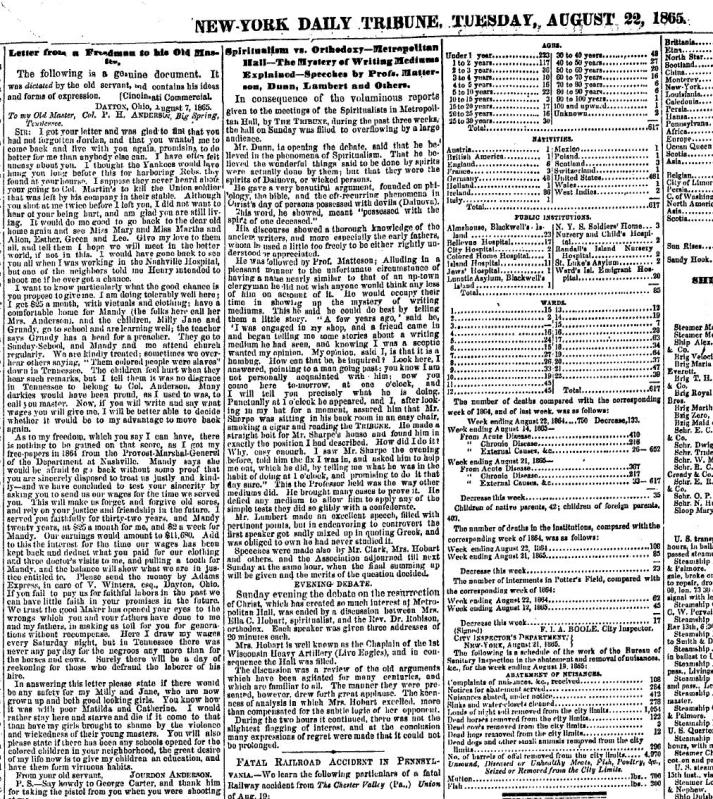
In August of 1865, a Colonel P.H. Anderson of Big Spring, Tennessee, wrote to his former slave, Jourdan Anderson, and requested that he come back to work on his farm. Jourdan — who, since being emancipated, had moved to Ohio, found paid work, and was now supporting his family — responded spectacularly by way of the letter seen below (a letter which, according to newspapers at the time, he dictated).

Rather than quote the numerous highlights in this letter, I'll simply leave you to enjoy it. Do make sure you read to the end.

(Source: The Freedmen's Book; Image: A group of escaped slaves in Virginia in 1862, courtesy of the Library of Congress.)


This letter is generally considered to be authentic.


Courtesy of Letters of Note.


Dayton, Ohio, 

August 7, 1865

To My Old Master, Colonel P.H. Anderson, Big Spring, Tennessee

Sir: I got your letter, and was glad to find that you had not forgotten Jourdon, and that you wanted me to come back and live with you again, promising to do better for me than anybody else can. I have often felt uneasy about you. I thought the Yankees would have hung you long before this, for harboring Rebs they found at your house. I suppose they never heard about your going to Colonel Martin's to kill the Union soldier that was left by his company in their stable. Although you shot at me twice before I left you, I did not want to hear of your being hurt, and am glad you are still living. It would do me good to go back to the dear old home again, and see Miss Mary and Miss Martha and Allen, Esther, Green, and Lee. Give my love to them all, and tell them I hope we will meet in the better world, if not in this. I would have gone back to see you all when I was working in the Nashville Hospital, but one of the neighbors told me that Henry intended to shoot me if he ever got a chance.

I want to know particularly what the good chance is you propose to give me. I am doing tolerably well here. I get twenty-five dollars a month, with victuals and clothing; have a comfortable home for Mandy,—the folks call her Mrs. Anderson,—and the children—Milly, Jane, and Grundy—go to school and are learning well. The teacher says Grundy has a head for a preacher. They go to Sunday school, and Mandy and me attend church regularly. We are kindly treated. Sometimes we overhear others saying, "Them colored people were slaves" down in Tennessee. The children feel hurt when they hear such remarks; but I tell them it was no disgrace in Tennessee to belong to Colonel Anderson. Many darkeys would have been proud, as I used to be, to call you master. Now if you will write and say what wages you will give me, I will be better able to decide whether it would be to my advantage to move back again.

As to my freedom, which you say I can have, there is nothing to be gained on that score, as I got my free papers in 1864 from the Provost-Marshal-General of the Department of Nashville. Mandy says she would be afraid to go back without some proof that you were disposed to treat us justly and kindly; and we have concluded to test your sincerity by asking you to send us our wages for the time we served you. This will make us forget and forgive old scores, and rely on your justice and friendship in the future. I served you faithfully for thirty-two years, and Mandy twenty years. At twenty-five dollars a month for me, and two dollars a week for Mandy, our earnings would amount to eleven thousand six hundred and eighty dollars. Add to this the interest for the time our wages have been kept back, and deduct what you paid for our clothing, and three doctor's visits to me, and pulling a tooth for Mandy, and the balance will show what we are in justice entitled to. Please send the money by Adams's Express, in care of V. Winters, Esq., Dayton, Ohio. If you fail to pay us for faithful labors in the past, we can have little faith in your promises in the future. We trust the good Maker has opened your eyes to the wrongs which you and your fathers have done to me and my fathers, in making us toil for you for generations without recompense. Here I draw my wages every Saturday night; but in Tennessee there was never any pay-day for the negroes any more than for the horses and cows. Surely there will be a day of reckoning for those who defraud the laborer of his hire.

In answering this letter, please state if there would be any safety for my Milly and Jane, who are now grown up, and both good-looking girls. You know how it was with poor Matilda and Catherine. I would rather stay here and starve—and die, if it come to that—than have my girls brought to shame by the violence and wickedness of their young masters. You will also please state if there has been any schools opened for the colored children in your neighborhood. The great desire of my life now is to give my children an education, and have them form virtuous habits.

Say howdy to George Carter, and thank him for taking the pistol from you when you were shooting at me.

From your old servant,

Jourdon Anderson.

_____________________________________________________________________
People have questioned the authenticity of the letter. There seems to be no absolute way to 100% verify its authenticity at this point especially without the letter reportedly sent to Jourdan Anderson. The leter did appear in several newspapers of the day. That lends some degree of credibility though that is not absolute.

Additionally...

Apparently, this letter is from a real book published in 1865 by an abolitionist named Lydia Maria Child. Apparently, the letter was dictated to a literate person by a recently freed slave. The letter could be a complete fabrication on her part, but that seems unlikely given that she names the slave master in question and gives his location. And she apparently also helped Harriet Jacobs with her own popular slave narrative, Incidents in the Life of a Slave Girl.

Child's work, including the book in which this letter appears, is discussed in the documentary Over the River. 

Lydia Maria Child (February 11, 1802 – October 20, 1880) was an American abolitionist, women's rights activist, opponent of American expansionism, Indian rights activist, novelist, and journalist and Unitarian.

Her journals, fiction and domestic manuals reached wide audiences from the 1820s through the 1850s. She at times shocked her audience, as she tried to take on issues of both male dominance and white supremacy in some of her stories.

Tuesday, October 18, 2011

Inspiration That Soothes The Soul Like a Long Cool Glass of Sweet Ice Tea Soothes The Body On a Warm Southern Eve: Necia D. Harkless


This is a woman I am happy and proud to call my friend. She is Necia Desiree Harkless. She is 91 years young. This is a very recent photograph. She lives in the town I was born in, Lexington, Kentucky. Although she had known my family for many years, we only formally met about thirteen years ago. We were both attendees, delegates and speakers at a spiritual conference being held in Kentucky. My maternal grandfather was a university professor. Necia is also a retired university professor. Back in the day, university professors of African Descent throughout the state all knew one other. That was for a number of reasons. Necia is truly a phenomenal woman: Educator, writer, pianist, piano instructor, published author (in the photo she is selling her book on Nubian Pharaoh's, an area of study and research that she is particularly knowledgeable in), social worker, Donovan Scholar, researcher, etc. Consider this post as an introduction to Necia on this blog. I am going to be composing numerous posts in the coming weeks about her. She inspires and encourages me just that much! I love you, Necia! Thank you for being born. Thank you for being in my life. Thank you for all your gifts

Wednesday, September 7, 2011

Friendships Between Black Men and White Women, Part I

In 1990 I enjoyed a very pleasant and nice lunch with a white female friend at a restaurant in a mid-sized Central Kentucky city. This was something we did frequently. We had arrived at the restaurant in my friends car. When we returned to her car to head home, someone had scrawled in the dirt on the car the words “nigger lover” on one of the car doors.

Four years later in the same state though in a different city approximately 30 miles away, I went to a different restaurant, a Denny's, after 1 am with several white gay male friends after having socialized together at a local gay bar until the bars closing time. The Denny's was located in one of the more diverse neighborhoods in this city of between 250,000 and 300,000. The neighborhood had a significant number though not a majority of African American residents. We all felt very comfortable in the neighborhood. We had all been to this Denny's as a group many times before. We were all very good friends and we always had a great time whenever we were all together. That early morning outing was no exception.

Sometime between our order being taken and when our food arrived, a young white woman we had not noticed earlier (I did say we were a group of gay men didn't I) walked up to a table not far from ours where a young black man and a young white woman were seated. The one white woman walked right up to the table, got about a foot from the face of the young woman sitting there and said in what seemed to be the loudest voice she could muster, “You are a disgrace to your race you f*king b*tch. You're nothing but a f*king nigger lover. Somebody ought to slap some f*king sense into you. And I just may be the one to do it”

It was an early Saturday morning. This Denny's was one of the few places open in the city after hours. Hence, it was fairly well packed with an extremely diverse group of people many of whom had similarly arrived from various watering holes throughout the city for an early morning snack or meal. There was a substantial wait staff on hand and there was a night shift manager on the premises who was a muscular white male who was the size and build of a professional wrestler. He appeared to be in his late 20s to early 30s.

The woman who came to the table of the black man and white woman did not stop her tirade after her initial outburst. She went on and on for what seemed like an eternity though in reality it was probably around 10 minutes. She never once acknowledged nor looked in the direction of the black man whatsoever. Her full and undivided attention was searingly focused on the other white woman. At one point she angrily challenged the woman sitting at the table to go outside with her and engage in a fight. The table she herself had been sitting at which contained a group of white men and woman loudly cheered her on when she proposed that challenge. For their part, the black man and the white woman sitting at the table didn't say a word. From the instant the one white woman had opened her mouth they lowered their heads and seemed to be wishing they each had the superpower of invisibility. None of the wait staff said a word throughout the entire tirade. The manager, who was visible to everyone throughout the incident, didn't say a word and took no action. No one in the restaurant said a word nor took any action. Finally, one of the white gay men at our table jumped up and rushed over to the manager, got in his face and screamed, “Will you call the f*king police or something a-hole!” At this, the screaming woman and all of her friends collected themselves and rushed out of the restaurant. I didn't notice if they paid their bill or not. The young black man and young white woman at the table kept their collective heads lowered, speechless. They were obviously traumatized. Everyone at my table openly vowed to never return to the restaurant again. I don't know about the others but I kept that promise. I and no one in the restaurant likely had any idea if the black man and white woman at the table were romantically linked or merely had a platonic relationship. There was no overt affection expressed between them. I for one have gone out numerous times and at all hours of the day and night with many different white female friends.

Now, when these two events took place I was in my early to mid 30s. I have other stories I could tell that both pre-date and post-date these two. They are stories that take place in this same part of the country and in other parts of the country as well. They are stories that occur in communities much smaller and communities much larger than these two. The common denominator in all of them is that they involve me—a black man, and at least one of my white female friends. For many years I have had many close and important relationships with white women. Not all of the stories I could tell involves racism and/or overt bigotry. They each however, express some of the numerous and complex dynamics that can be present whenever black men and white woman develop friendships in a decidedly race and gender conscious culture and where black men and white woman are often viewed as being at opposing ends of that cultural channel. So many things come into play here—power dynamics, money, socioeconomic statuses, sexuality, classism, perceived gender and race based cultural worth, etc. The most horrifying of the stories I could tell involves me and one of my very closest white female friends who at the time the story takes place was pregnant. Hint: It too took place in The American South and the lovely people we encountered on that fateful day mistakenly made the assumption I was the father of my friends unborn child...
©Raven/Sage Mahosadha

Monday, August 15, 2011

I Am A Man

Sanitation worker Ben Jones, 71 years old at the time this photo was taken in 2008, holds a replica placard of the words made famous by strikers in Memphis who demanded better wages and respect. He used to tell his wife, "I might be back and I might not," as tensions peaked in 1968. Photo Credit Carl Juste/Miami Herald Staff.

Thursday, July 7, 2011

Black Thursday: A Photo Essay By Sage

A tour around the world and around the world's religions through the lens of some of the world's black and dark blue spiritual guides.

One reason I chose to create this photo essay is for it to represent a certain type of spiritual empowerment that is available specifically to people of the African Diaspora simply through the presence of these images. Similarly, I also believe these images can provide a certain type of empowerment to LGBT people as well. Symbolically, the color black, from a spiritual understanding of the universal color spectrum, represents overcoming obstacles, transmuting negativity into something more beneficial--usually compassion and wisdom, letting go, particularly the letting go of rage, transmuting the "darkness" in us, etc. These are awarenesses that can easily be translated into everyday practices that can be beneficial to anyone especially however, those who are victims of oppression of any kind. We can develop practices around any of the "dark" spiritual guides," particularly "the dark mother" without a corresponding religious devotion or "worship" of such figures.

Yes, it is true. The Dark Mother, for example, is an absolutely universal concept that crosses many cultural and religious/spiritual lines. The Black Madonnas of Catholicism, Kali, from Hinduism, Isis from ancient Egyptian religions and Black Tara from Buddhism are all considered expressions of The universal Black or Dark Mother. Their appearance may at times seem quite frightening and/or foreboding. However, they are primarily spiritual mother figures. Remember that. Still, there is an undeniable type of "fierceness" in them. This type of fierceness however, is well known and respected in the LGBT community, particularly the African American, trans and drag queen communities. So this makes The Black Mother exceedingly accessible to many members of the LGBT community. These practices I speak of, at their most basic expression, simply involves us allowing or inviting the "dark spiritual guide" to be a channel for positive transformation within us. They do not need to involve worship or devotion of any kind. In other words, these practices are available to those who view themselves as atheist or agnostic as well. I plan to say much more about all of this in future posts here at moyo afame.

Ashé. Namaste'. Om Shanti Shalom. Amen. And So It Is.


Depiction of Jesus,The Nazarean, as a member of The African Diaspora (Jamaica)
"Rasta Jesus" Painting by Frank Hazen
(Christianity)

Bronze statue depicting The Buddha as a member of The African Diaspora
"Black Buddha"
(Buddhism)

Our Lady of Częstochowa, one of world's many "Black Madonnas" (Poland)
(Christianity/Catholicism)

Our Lady of Candelaria, one of the world's many "Black Madonnas" (Canary Islands)
(Christianity/Catholicism)

Our Lady of Einsedeln, one of the world's many "Black Madonnas (Switzerland)
(Christianity/Catholicism)

Medicine Buddha (Buddhism)

Kali (Hinduism)

Black Tara (Buddhism)


Isis (Ancient Egyptian Religious System)
(Egypt, Northern Africa)


Krishna (Hinduism and incarnations in other world religions)


Monday, June 6, 2011

When Love Takes Over: Introducing Darian Aaron's New Book on Same Gender Loving Couples of Color


In the words of Darian Aaron, the author of this new book...

"I am thrilled to announce that the book that caused my long hiatus from the blog last year is now available for purchase. When Love Takes Over: A Celebration of SGL Couples of Color is based on the popular Coupled Up series from loldarian.com and exclusively profiles eighteen African-American gay couples who are in committed long-term relationships. The couples detail how they met, their journey towards self-acceptance, liberation and ultimately how they fell in love and maintain their relationships. All the while defying the myth that two black men are incapable of loving each other for a lifetime.

The arrival of this book is timely and necessary. The gay and mainstream media has largely ignored black same-gender loving men who have formed nurturing and long-term relationships, even worse; the love shared between these brave men have often been met with hostility from individuals within their own community. But finally, the diversity that exists within both the African-American and gay communities are laid out in the pages of “When Love Takes Over” for the entire world to see."

Run, not walk here to order your copy of Darian's book. Visit Darian's blog here. You can also order a copy of this book from Amazon.com right here on this blog with the Amazon tool on the right sidebar.

Saturday, March 12, 2011

Thinking this morning of my beloved Langston...


The Negro Speaks of Rivers
By Langston Hughes

I've known rivers:

I've known rivers ancient as the world and older than the
      flow of human blood in human veins.

My soul has grown deep like the rivers.

I bathed in the Euphrates when dawns were young.
I built my hut near the Congo and it lulled me to sleep.
I looked upon the Nile and raised the pyramids above it.
I heard the singing of the Mississippi when Abe Lincoln
       went down to New Orleans, and I've seen its muddy
       bosom turn all golden in the sunset.

I've known rivers:
Ancient, dusky rivers.

My soul has grown deep like the rivers.

Langston Hughes 1902 - 1967

Photo Credit: Gordon Parks 1912 - 2006

Thursday, February 24, 2011

I Am Sean Bell By Stacey Muhammad


I AM SEAN BELL (10:36 min) Directed by Stacey Muhammad Produced by Stacey Muhammad Winner of the Speaking Out Award

Here is the wikipedia link detailing the events this film speaks about. You will find the 10 minute short film at the end of this post.

I got this from my friend William Harryman over at The Masculine Heart blog. Bill always has insightful and extremely diverse pieces on his blog about absolutely anything pertaining to the lives of males and how we can improve those lives.

A Statement by the filmmaker 

I’ve loved film for as long as I can remember. Initially, screenwriting was my interest; however, I wanted to see my ideas come to life beyond the writing. This led to a desire to acquire the skills needed to actually produce my own projects. So, I embarked upon the journey of studying and learning as much about the filmmaking process as I possibly could by attending film school, workshops, and anything else I could find.

First and foremost, I consider myself an activist, so I’m drawn to human issues and subjects that enlighten and uplift humanity while challenging us to examine our ideals and issues on this planet. I’ve always been drawn to documentary filmmaking, particularly as an activist. It’s a powerful way to communicate with an audience.

When I chose to do the Sean Bell film, I was extremely disturbed by the verdict and wanted to hear from the children, particularly young black boys, about their thoughts, fears and concerns regarding violence against black men. Most of the topics that interest me are those that give a voice to those often unheard populations of people, who indeed have stories to tell and victories to celebrate.

One thing that I’ve learned is that life is what it is—meaning, everything we do and experience is connected. Often, we try to compartmentalize our lives and deal with different aspects of our experience (be it our personal lives, our career, etc.). Filmmaking, for me, is a spiritual process and journey. I’ve been prepared through life experiences, for each and every topic I choose to explore.

So, my advice to any aspiring filmmaker would be to live your life with integrity, take care of yourself, learn as much about your craft as possible, commit to creating the life you desire and expect the universe to grant you everything you ask.

A brief bio of Ms. Muhammad

Stacey Muhammad is an award-winning independent filmmaker and activist committed to using the power of media to educate, enlighten and empower humanity. Her first film, A Glimpse of Heaven, The Legacy of the Million Man March, screened at the Reginald F. Lewis Museum in Baltimore, MD in 2005 and received rave reviews.

Since that time, the New Orleans native has begun the work of documenting and preserving Hip Hop culture through film and digital media. Her projects include several multi-media projects, music videos and short form documentaries, including, the acclaimed I AM SEAN BELL, black boys speak, which made it’s film festival premier at the New Orleans International Human Rights Film Festival.

Ms. Muhammad has worked with several media outlets and hip hop artist and has lectured and participated in numerous panel discussions about filmmaking and hip-hop culture. As co-founder of IntelligentSeedz, she is committed to giving at risk youth the necessary skill set to tell their unique stories through film.

The film I am Sean Bell 
I AM SEAN BELL, black boys speak from Stacey Muhammad on Vimeo. Stacey Muhammad's website is here.

Tuesday, December 28, 2010

The History of Kwanzaa


The History of Kwanzaa
December 26th - January 1st
By The Szaflik Family

Kwanzaa, an African-American holiday which celebrates family, community, and culture, is the fastest growing holiday in the U.S. An estimated 18 million Africans celebrate Kwanzaa each year around the world, including celebrants in the U.S., Africa, the Caribbean, South America, especially Brazil, Canada, India, Britain and numerous European countries.

The holiday was created by Dr. Maulana Karenga, a scholar-activist who is currently professor and chair of the Department of Black Studies at California State University at Long Beach. Several cities in the U.S. have issued proclamations in honor of the celebration of Kwanzaa. Among them are Baltimore, Buffalo, Los Angeles, Miami, Newark, New Orleans, New York, and Philadelphia.

Kwanzaa as an African-American holiday belongs to the most ancient tradition in the world, the African tradition. Drawing from and building on this rich and ancient tradition, Kwanzaa makes its own unique contribution to the enrichment and expansion of African tradition by reaffirming the importance of family, community, and culture.

In his book titled, The African-American Holiday of Kwanzaa: A Celebration of Family, Community, and Culture, Dr. Karenga explains that KWANZAA is based on ancient African harvest celebrations. The word KWANZAA comes from the Swahili phrase "matunda ya kwanza" which means "first fruits." KWANZAA is celebrated seven days, from December 26th through January 1st, a period which represents the end of an old year and the beginning of a new one. This time in African culture is called "the time when the edges of the year meet," which is a time of celebration, focus, and assessment.

African harvest celebrations have five basic aspects which KWANZAA also shares. They are: 1) in gathering of the people; 2) special reverence for the Creator and creation, especially thanksgiving and commitment; 3) commemoration of the past, especially paying homage to the ancestors; 4) re-commitment to our highest ethical and cultural values, especially Nguzo Saba (The Seven Principles); and 5) celebration of the Good of life, especially family, community, and culture.

Dr. Karenga created Kwanzaa to reaffirm African-Americans' rootedness in African culture, to reinforce the bonds between them as a people, and to introduce and reaffirm the value of the Nguzo Saba, The Seven Principles of Kwanzaa. The central reason Kwanzaa is celebrated for seven days is to pay homage to The Seven Principles of Kwanzaa which in Swahili are: Umoja, Kujichagulia, Ujima, Ujamaa, Nia, Kuumba, and Imani. The principles are also known as The Seven Principles of African American community development and serve as a fundamental value system.

Kwanzaa is represented by seven symbols: Mazao (crops), Mkeka (mat), Kinara (candle holder), Mishumaa Saba (seven candles), Muhindi (ears of corn), Zawadi (gifts), and Kikombe Cha Umoja (unity cup). The candle holder has seven candles, one black, three red and three green. The colors are black for Black people, red for their struggle and green for the hope and future that come from the struggle.

Each ear of corn represents the children in the family and community. The gifts are primarily for the children, but other family members can also receive gifts. The gifts should include a book and a heritage symbol to stress the ancient and continuing stress on the value of education and reaffirm the importance of culture and tradition. The unity cup is used to pour libation for the ancestors and it is drunk from as a ritual to reinforce unity in the family and community. All seven symbols are put on a Mkeka (straw mat). The Kwanzaa setting piece which includes the seven symbols is placed on a table or any other central location in the home.

The lighting of the candles begins on the first day of Kwanzaa, December 26th. The black candle is the first candle lighted. The second day of Kwanzaa, the black candle is relighted as well as the first candle to the left, a red candle, December 27th. Each day every candle which has been lighted is relighted along with the next candle of that day. Candles are lighted left to right alternately. The lighting practice is ordered to represent first the people (the black candle), then the struggle (the red candle), then the future and hope (the green candle) which comes from the struggle.

December 31st is the evening upon which the Kwanzaa Karamu (Feast) is held. This special evening is a time for feasting upon a variety of African-influenced meals as well as acknowledging the importance of history, culture, and family. (Check out the Kwanzaa Recipes in our main collection!)

When preparing for this special evening, special items, or symbols, are necessary. There are seven symbols. These items should be displayed as part of the Kwanzaa Karamu:
1) Mazao (fruit and vegetables)
2) Mkeka (place mat)
3) Kinara (candle holder for seven candles)
4) Vibunzi (ears of corn reflective of the number of children in the home)
5) Zawadi (gifts - usually for the children)
6) Kikombe Cha Umoja (community cup)
7) Mishumaa Saba (the seven candles)