Loving Kindness

Loving Kindness
Showing posts with label white privilege. Show all posts

Tuesday, January 31, 2012

LETTER FROM A FREEDMAN TO HIS OLD MASTER


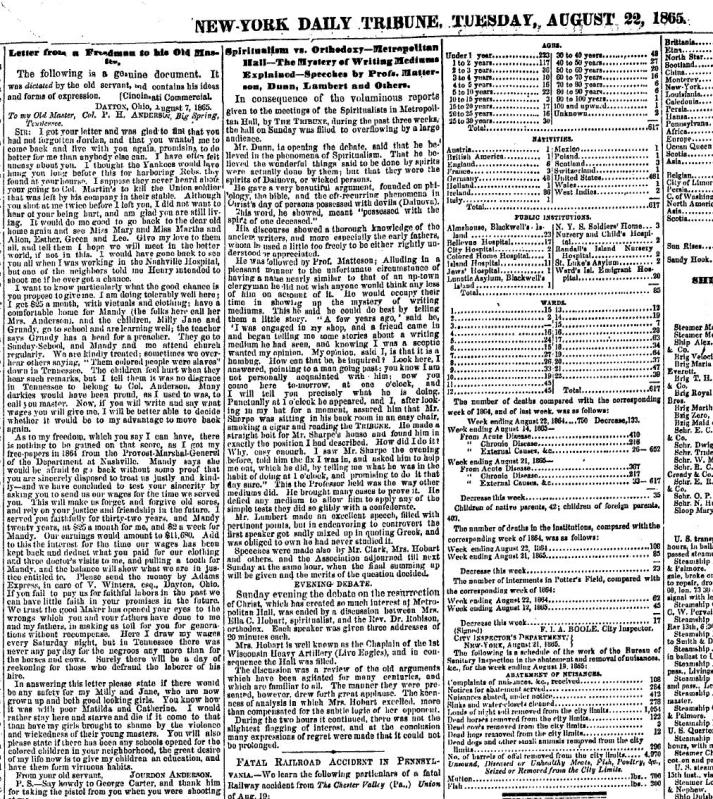
In August of 1865, a Colonel P.H. Anderson of Big Spring, Tennessee, wrote to his former slave, Jourdan Anderson, and requested that he come back to work on his farm. Jourdan — who, since being emancipated, had moved to Ohio, found paid work, and was now supporting his family — responded spectacularly by way of the letter seen below (a letter which, according to newspapers at the time, he dictated).

Rather than quote the numerous highlights in this letter, I'll simply leave you to enjoy it. Do make sure you read to the end.

(Source: The Freedmen's Book; Image: A group of escaped slaves in Virginia in 1862, courtesy of the Library of Congress.)


This letter is generally considered to be authentic.


Courtesy of Letters of Note.


Dayton, Ohio, 

August 7, 1865

To My Old Master, Colonel P.H. Anderson, Big Spring, Tennessee

Sir: I got your letter, and was glad to find that you had not forgotten Jourdon, and that you wanted me to come back and live with you again, promising to do better for me than anybody else can. I have often felt uneasy about you. I thought the Yankees would have hung you long before this, for harboring Rebs they found at your house. I suppose they never heard about your going to Colonel Martin's to kill the Union soldier that was left by his company in their stable. Although you shot at me twice before I left you, I did not want to hear of your being hurt, and am glad you are still living. It would do me good to go back to the dear old home again, and see Miss Mary and Miss Martha and Allen, Esther, Green, and Lee. Give my love to them all, and tell them I hope we will meet in the better world, if not in this. I would have gone back to see you all when I was working in the Nashville Hospital, but one of the neighbors told me that Henry intended to shoot me if he ever got a chance.

I want to know particularly what the good chance is you propose to give me. I am doing tolerably well here. I get twenty-five dollars a month, with victuals and clothing; have a comfortable home for Mandy,—the folks call her Mrs. Anderson,—and the children—Milly, Jane, and Grundy—go to school and are learning well. The teacher says Grundy has a head for a preacher. They go to Sunday school, and Mandy and me attend church regularly. We are kindly treated. Sometimes we overhear others saying, "Them colored people were slaves" down in Tennessee. The children feel hurt when they hear such remarks; but I tell them it was no disgrace in Tennessee to belong to Colonel Anderson. Many darkeys would have been proud, as I used to be, to call you master. Now if you will write and say what wages you will give me, I will be better able to decide whether it would be to my advantage to move back again.

As to my freedom, which you say I can have, there is nothing to be gained on that score, as I got my free papers in 1864 from the Provost-Marshal-General of the Department of Nashville. Mandy says she would be afraid to go back without some proof that you were disposed to treat us justly and kindly; and we have concluded to test your sincerity by asking you to send us our wages for the time we served you. This will make us forget and forgive old scores, and rely on your justice and friendship in the future. I served you faithfully for thirty-two years, and Mandy twenty years. At twenty-five dollars a month for me, and two dollars a week for Mandy, our earnings would amount to eleven thousand six hundred and eighty dollars. Add to this the interest for the time our wages have been kept back, and deduct what you paid for our clothing, and three doctor's visits to me, and pulling a tooth for Mandy, and the balance will show what we are in justice entitled to. Please send the money by Adams's Express, in care of V. Winters, Esq., Dayton, Ohio. If you fail to pay us for faithful labors in the past, we can have little faith in your promises in the future. We trust the good Maker has opened your eyes to the wrongs which you and your fathers have done to me and my fathers, in making us toil for you for generations without recompense. Here I draw my wages every Saturday night; but in Tennessee there was never any pay-day for the negroes any more than for the horses and cows. Surely there will be a day of reckoning for those who defraud the laborer of his hire.

In answering this letter, please state if there would be any safety for my Milly and Jane, who are now grown up, and both good-looking girls. You know how it was with poor Matilda and Catherine. I would rather stay here and starve—and die, if it come to that—than have my girls brought to shame by the violence and wickedness of their young masters. You will also please state if there has been any schools opened for the colored children in your neighborhood. The great desire of my life now is to give my children an education, and have them form virtuous habits.

Say howdy to George Carter, and thank him for taking the pistol from you when you were shooting at me.

From your old servant,

Jourdon Anderson.

_____________________________________________________________________
People have questioned the authenticity of the letter. There seems to be no absolute way to 100% verify its authenticity at this point especially without the letter reportedly sent to Jourdan Anderson. The leter did appear in several newspapers of the day. That lends some degree of credibility though that is not absolute.

Additionally...

Apparently, this letter is from a real book published in 1865 by an abolitionist named Lydia Maria Child. Apparently, the letter was dictated to a literate person by a recently freed slave. The letter could be a complete fabrication on her part, but that seems unlikely given that she names the slave master in question and gives his location. And she apparently also helped Harriet Jacobs with her own popular slave narrative, Incidents in the Life of a Slave Girl.

Child's work, including the book in which this letter appears, is discussed in the documentary Over the River. 

Lydia Maria Child (February 11, 1802 – October 20, 1880) was an American abolitionist, women's rights activist, opponent of American expansionism, Indian rights activist, novelist, and journalist and Unitarian.

Her journals, fiction and domestic manuals reached wide audiences from the 1820s through the 1850s. She at times shocked her audience, as she tried to take on issues of both male dominance and white supremacy in some of her stories.

Tuesday, August 30, 2011

Spiritual Practice, Racism, White Privilege and the Spiritual Concept of Liberation (Part I)


I belong to many spiritually oriented groups. I have for a very long time. I know an exceptionally large number of people who consider themselves to be anywhere from moderately to significantly “spiritual.” Many of these people do not talk about or even acknowledge racism in their everyday and and in some cases voluminous writings, discourses and “satsangas.” Even fewer talk about or even acknowledge white privilege. Why is this? I believe a large part of the answer lies in the concept of liberation as defined and employed by a large and diverse cross section of spiritual seekers.

More specifically, many so called spiritual seekers have a concept of liberation that is heavily weighted toward personal liberation. In other words it is a liberation that places emphasis on individual enlightenment and achievement. Meaning it de-emphasizes, de-legitimizes and in its more extreme cases effectively disappears the understanding of liberation as a direct result of the combination of spiritual practice and social justice action. Though many who view themselves as “highly spiritual” will also often give superficial and for them, adequate lip service to some of the more basic ideas that find a much more distilled and developed expression in such teachings as Engaged Buddhism as taught by spiritual masters such as Thich Nhat Hanh and others.

Second, being a spiritual seeker/person does not unfortunately automatically exempt one from being a human being. And we human beings notoriously avoid things that make us uncomfortable. Racism and white privilege are exceedingly uncomfortable conversations in this culture. This is why Tim Wise, antiracism and white privilege teacher and essayist extraordinaire, receives so many death threats and on a very regular basis. Oddly, it is this very type of avoidance that many spiritual practices and teachings would have us deeply explore, investigate and come to terms with. Habit energy however, is oftentimes stronger and more influential than even the most sublime and beautiful spiritual teachings. So when habit energy, especially when enhanced with a certain type of abstract intellectualism, exist in a spiritual seeker, denial and avoidance are often the result.

So, for those keeping score, we so far have concern with and the primacy of personal liberation and habit energy as reasons why more spiritual people do not talk about and try to actively impact social understanding and social change around the issues of racism and white privilege. To these we can now add what I like to call “above the fray-ism.” Above the fray-ism is when so called spiritual or religious people make a distinction and draw lines of demarcation between their psycho-emotional lives, their social observation and participation and their spiritual aspirations. The so called spiritual aspirations become the locus of focus while psycho-emotional and social observation and participation become the frays one must effectively rise above. Certain strains of neo-advitin (with an ostensibly Hindu foundation) philosophy but also numerous strains of fundamental Christianity and other fundamental religious/spiritual expressions are good examples of systems that employ above the fray-ism an an integral aspect of their belief systems. Above the fray-ism of course does not just nullify discussions of racism and white privilege it nullifies pretty much all discussions of anything that could be considered a social ill, problem or concern. Another, more basic understanding of above the fray-ism is to simply call it denial. Though it is a type of denial that includes some elements that are not necessarily found in plain ole, run of the mill denial. There are expressions of self righteousness and bullying here that don't always show up in plain ole, run of the mill denial. One can, for example, believe global warming simply does not exist with no other energy maintaining that belief other than ignorance, environmental blindness and perhaps a certain level of naiveté. The type of denial I am speaking of here has all the elements of run of the mill denial with the additional strong belief that others simply are not as smart, evolved, aware or conscious with the added strong need to convince those others of all of that.

Finally, there is probably privilege and perhaps even racism experienced by some of the spiritual people in question here and that prevents such spiritual people from speaking out against and about white privilege and racism. Aside from politicians and the CEOs of many large corporations and certain large non-profits, I have not observed too many people who are able to expertly talk out of both sides of their mouths with extreme and pathological proficiency while simultaneously convincing the masses (or their constituency) of their sincerity. In other words, some spiritual people probably don't speak out too much about racism and white privilege because they are consciously or unconsciously, actively or passively--psychologically, emotionally, financially and/or in other ways, participants in and beneficiaries of both.

Saturday, August 20, 2011

Racism and Other Related Topics 101: Broken Down and Made Simple


Racism

Racism is the belief in inherent racial differences amongst and between different sets of people's. This belief is then used as a justification for non-equal treatment of the entire population of members of a certain race (sic). The important knockout punch here and that is packed with racism is provided by this—a group possessing the belief in these inherent differences also possessing the social capitol and “power” to enforce their racist views and beliefs within a cultural, governmental and/or global context. This understanding is also one of the core elements behind the term “institutionalized” or “structural" racism.

Most post modern biologists, anthropologists and sociologists reject the idea of “race” that is an important aspect of the concept of racism, preferring to rely on more empirically verifiable concepts such as ethnicity. These truths however, have not found their way into the common understanding of the average person nor has the power of racism been significantly reduced and certainly not nullified as a result of this fact.

Institutionalized Racism (aka: Structural Racism)

Institutionalized racism occurs when racist ideas, philosophies, attitudes and enforcement become enshrined in a culture’s fundamental and important institutions such as a cultures governmental institutions, financial institutions, educational institutions, political institutions, judicial institutions, law enforcement institutions, etc. It is racial discrimination by these and other large and powerful institutions that have the power to influence the lives of a very large cross section of people. Stokely Carmichael is credited with inventing the term in the late 1960s.

With these understandings it becomes clear that one and only one socio-political cultural group on the planet has the inherent and demonstrated power to universally translate the racism that exists in the hearts, souls and minds of some of its members, into a powerful channel of enforcement—white people.

Prejudice

Prejudice is simply a pre-judgment or assumptions made about someone or a group of people without the requisite or corresponding knowledge or information to substantiate such a judgment.

Discrimination

Discrimination is prejudicial treatment of an individual or an entire group of people based solely on their membership in a certain group.

Reverse Racism”

Other ethnic groups such as African American's, Arabs, Latinos, Ethnic Chinese, various Indigenous Peoples, American Indians, Jews (who do not assimilate as whites) and others may have members who hold extremely biased and prejudiced attitudes and beliefs against other races (sic) and ethnic groups. None of these groups however, have historically nor in current times had the same degree of social power to enforce their views in the same ways that white people have. Such people and groups may have the power to enforce such views regionally but certainly not globally. The sheer overarching power of white people on a global and social scale is simply too massive for that.

Such ethnic groups may also have members who believe their racial (sic) or ethnic group is superior to white people. In a practical sense, this does not matter because there is no corresponding social power to enforce such a stance on global cultural reality. The most such an ethnic group member can engage in is hate speech and/or ethnically based terrorism and/or ethnic cleansing. These are terrible and horrifying sure enough. This however, is not the same as having the global power and all the systems thereof to back up ones actions with. And in any case hate speech, terrorism, and genocide/ethnic cleansing are also the evidential purview of white racists/supremacists as well, as history has well taught us and continues to teach us. 

Whatever non white racial (sic) or ethnic group such a person is a member of will be one that does not ultimately possess the overarching social power to enforce such beliefs in anywhere near the degree a white person/group would be able to.

Given this understanding, a term such a “reverse racism” is essentially a red herring/straw man of a term primarily used to confuse, manipulate and alter the truth/discourse in conversations around race, ethnicity, power, white privilege, etc. The phrase has no real meaning except in the minds of those who choose to use or believe in the legitimacy of such a term. In reality this term is a made up term with no real practical or legitimate social meaning whatsoever.

Playing the Race Card”

Similarly, the phrase “playing the race card” is also a red herring/straw man of a phrase. This term is often used as an indication that a member of any racial (sic) or ethnic group other than white people has the power in fact to use their very real societal and cultural victimization in a way to gain some kind of real demonstrable power in a specific situation. For example, it is often used in legal/courtroom proceedings as a way to present the theory that a real or imagined crime committed by a member of a non-dominant racial or ethnic group such as African Americans, can be minimized, justified or erased because the person belongs to a group that has historically been victimized in one or more ways. This is what people who believe in the concept of reverse racism would like us all to believe. It is essentially a very well constructed wool such people attempt to use to pull over the eyes of unsuspecting naive people and people who don't really have a firm grasp on how white privilege and racism intercept in the world.

Here is what people who believe in reverse racism don't want you to know: In reality, it is only white people who can consistently and successfully use the so called race card against members of other racial (sic) and ethnic groups because only white people, in most situations, have the social capitol and power to do so. An example of this can be seen in the 2008 general election in California specifically regarding the ballot initiative known as Proposition 8. Here was an initiative that set out to define marriage as something that could only legitimately exist between one man and one woman. In essence it was an attempt to even further marginalize non-heterosexual or same gender loving/LGBT relationships. Proposition 8 passed in the state of California. After the polls closed, a theory was put forth that the proposition passed as the direct result of a high number of African American and Latin voters in California voting in favor of the discriminatory proposition. In this instance, the playing of the race card was successfully used primarily by members of the white, gay male communities of California. African American and Latin LGBT people in California (and beyond) suffered a tangible and in some cases, a physically violent backlash from this that would not have been suffered by white LGBT people to the same extent if the tables had been turned. This is because African American and Latin LGBT people do not have anywhere near the social capitol nor political power within either the larger United States cultural milieu nor the mainstream LGBT communities within America that their white especially male counterparts possess.

Other historical examples of this same applied principal/understanding are:

A. The way Japanese Americans were treated and perceived by the general American populous, at the time, in America, after the bombing of Pearl Harbor.

B. The way Muslim and Arab Americans have been treated and perceived by the general American populous since 9/11

C. The way Native Americans/American Indians/First Nation Peoples have been treated and perceived in America and Canada since their lands were invaded and stolen by European colonists and invaders for the last several hundred years in North and South America.

D. The type, breadth and scope of disrespect, name calling and vitriol shown to President Barack H. Obama by members of the media, political pundits and and those who make their living through political commentary and that is unprecedented in modern American politics, including during the 2 presidential terms of George W. Bush.

White Privilege

White privilege is the belief that whites hold a large number of advantages in the world that are implicit and explicit and granted to them in society simply for being white. It is similar to The Fundamental Attribution Error found in the field of psychology.

Some people who dispute the existence of white privilege often like to site the fact that whites also suffer death, hardship, unemployment, homelessness, poverty, illness and all manner of social ills just like everyone else as proof that white privilege does not exist. This is essentially an ad hominen argument because the critical race theory by which the concept of white privilege came about never purported an understanding of white privilege as being akin to a comic book like super power that white people supposedly possess. Quite the contrary. White privilege is the expression of a normative structure in society that explicitly and implicitly both simultaneously provides societaladvantage to whites and societal disadvantage to non-whites. It has to do with the normalization of part of one's identity (whiteness) in a way that is so congruent with being a member of the dominant culture for there to be little or no distinction between the two.